
U.S. renter guide · reviewed October 2026
What Can a Landlord Deduct from a Security Deposit?
Review the reason, amount, lease terms, condition records, and state rules behind each charge before you decide how to respond.
Last reviewed:
Quick answer
A charge is not automatically valid just because it appears on a statement.
For the question “what can a landlord deduct from a security deposit,” start with the law for your rental’s state: In the United States, there is no single list that decides every security deposit dispute. State law sets the legal boundary, the lease may matter where the law allows, and the facts and records help show whether a particular amount is supported.
Start by identifying each line item. Then check the reason, compare move-in and move-out condition, look for an itemized amount or invoice, and confirm your state’s notice and return rules. A landlord’s description is one piece of information, not a final legal decision.
This page is a review framework for U.S. residential rentals, not a legal ruling. Some state and local rules differ, and deadlines change by jurisdiction.
Which charges may appear on a security deposit itemization?
A security-deposit statement may list more than one kind of claim. Common categories include unpaid rent, damage a tenant allegedly caused, cleaning tied to the condition at move-out, or another amount that a lease and local law permit. The category alone does not show that the charge is valid in your situation.
For each line, separate four questions: what rule allows it, what event or condition is being claimed, how the amount was calculated, and what proof supports it. Ask for details when a statement says only “repairs,” “cleaning,” or “miscellaneous.”
Unpaid rent or another amount due under an agreement
Compare the amount with your payment history, move-out date, and any written agreement. Check whether the claimed balance includes a fee, utility bill, or other amount that state law and your lease actually allow the landlord to collect from the deposit.
A ledger should make the dates and arithmetic understandable. If you paid part of a month, reached a written move-out agreement, or dispute a fee, preserve the receipt and the message that explains the arrangement.
Damage beyond ordinary use
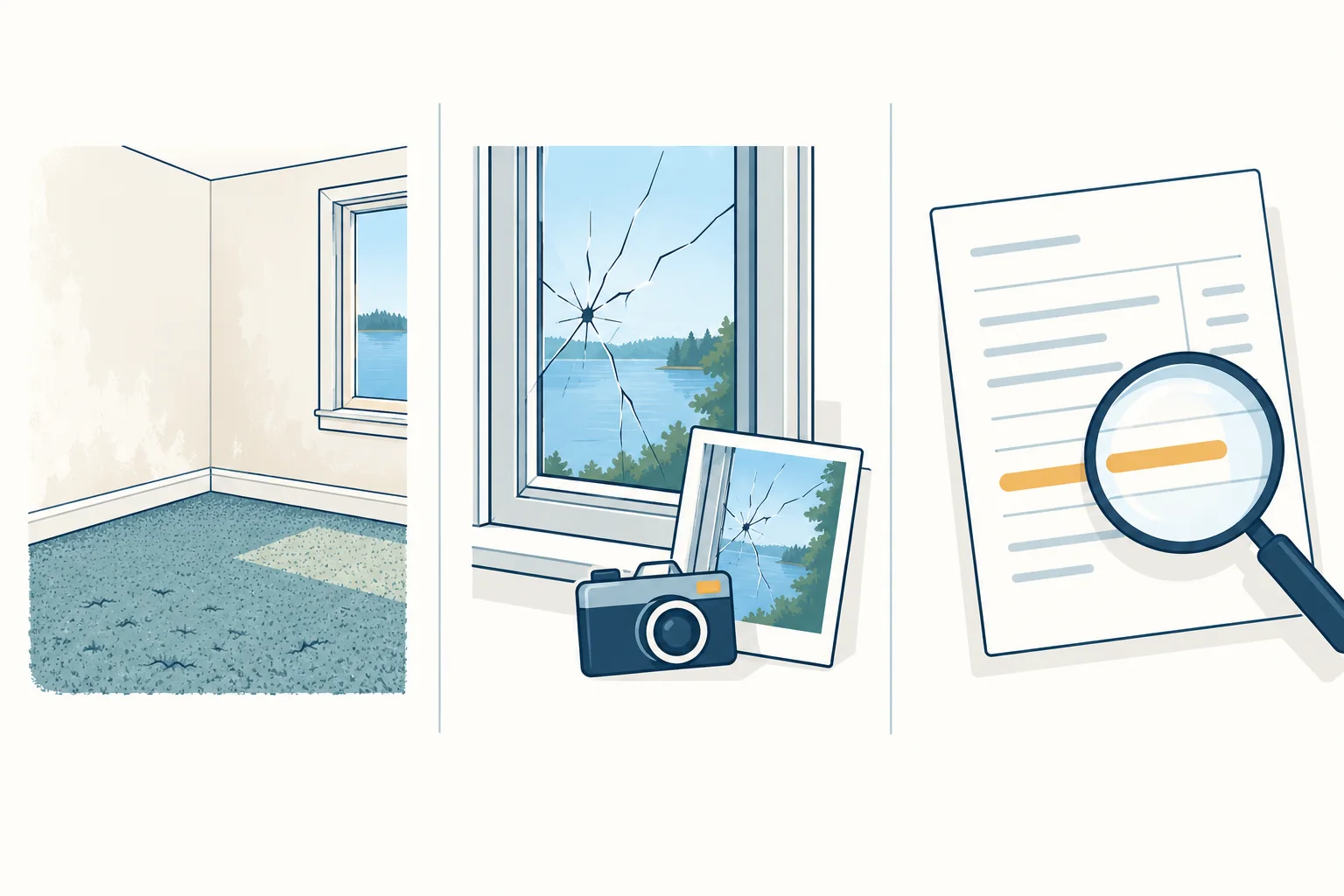
A landlord may claim that a tenant caused damage, but the label does not establish who caused it or what a reasonable repair costs. Compare the claimed condition with the move-in checklist, dated photos, inspection notes, and any earlier repair request.
Ask what was repaired, whether the work addressed a tenant-caused condition rather than age or a pre-existing problem, and whether the charge is for a repair or a larger replacement. Rules about proof, depreciation, and recovery vary by state.
Cleaning tied to the move-out condition
A cleaning charge should be checked against the condition in which you received the unit, the condition when you returned it, the lease, and the applicable state rule. Routine turnover work and a specific tenant-caused cleaning need may be treated differently, so do not assume that every cleaning fee is allowed or forbidden nationwide.
Request an itemized description, date, and actual cost basis. Compare room-by-room photos and inspection records instead of relying on a generic “move-out cleaning” label.
Other fees, utilities, or missing property
Late charges, utilities, keys, abandoned property, or lease-break amounts may depend on a statute, a valid lease term, required notices, and the facts. A lease clause is not a substitute for checking state law, and a landlord’s internal policy does not by itself prove that a deduction is permitted.
If the line item does not identify the rule or calculation, ask for the lease provision or legal basis and the records supporting the amount before treating it as settled.
| Statement line | What to verify | Records that may help |
|---|---|---|
| Unpaid rent or balance | Dates, credits, lease terms, and whether the amount may be taken from the deposit | Rent ledger, bank or payment receipts, written agreement |
| Repair or replacement | Cause, starting condition, work performed, actual cost, and whether age or an upgrade is included | Move-in/move-out photos, inspection reports, invoice, repair request |
| Cleaning | Specific condition, comparison with move-in, and the rule that applies in your state | Room photos, checklist, itemized bill, lease |
| Utilities or other fee | Who owed it, amount due, required notice, and legal/contract basis | Final bill, account statement, lease clause, notices |

How should you compare ordinary wear with claimed damage?
Ordinary wear generally describes gradual change from normal use; damage usually refers to a specific condition alleged to have been caused by the tenant. The dividing line depends on the facts and jurisdiction. A single photo or label rarely answers every question, so compare the same area at move-in and move-out and note the age and prior condition of the item.
Use the examples below to decide what to investigate, not to reach an automatic legal conclusion. Local statutes, lease terms, item age, cause, and the actual work needed can change the analysis.
Compare like with like
A faded wall or a carpet path may reflect time and ordinary use; a deep gouge, burn, or large hole may call for a closer look at the cause and repair. Those descriptions are prompts for review, not a universal rule about who must pay.
For a replacement charge, ask whether the old item could be repaired, how old it was, what comparable replacement was installed, and whether the amount accounts for age or improvement where local law requires it.
| Condition to review | Questions to ask before accepting the charge |
|---|---|
| Light scuffs, faded paint, or gradual carpet wear | Was the change consistent with ordinary use and the item's age? What does the move-in record show? |
| Large hole, burn, broken fixture, or unusual stain | What evidence links it to the tenancy? What specific repair was done and what did it cost? |
| Full carpet, flooring, or appliance replacement | Could repair work address the issue? How old was the item? Does the requested amount include an upgrade? |
How to review an itemized security deposit deduction in six steps
Work through the statement one line at a time. This makes a response more useful than a general objection because you can point to the exact charge, missing record, or arithmetic question you want clarified.
Use a side-by-side condition record
Keep the lease, move-in checklist, move-out photos, payment records, messages, repair requests, and the landlord’s statement together. Label photos with the date and room when you can. Save the original files and do not edit them in a way that removes date or context information.
If you have no move-in photo, other records may still help: an inspection form, a maintenance request, a message to the landlord, or a prior listing photo. Note which facts are known and which are uncertain.
- Identify the applicable state and local rules
Use the property’s location, rental type, move-out date, and any relevant local ordinance to find the current rule. A national article cannot supply the deadline or allowed categories for every home.
- Copy each line item and check the math
Record the charge, the amount returned, and any amount held back. Confirm the totals add up to the original deposit and that credits or payments are shown correctly.
- Ask what legal or lease basis applies
For each charge, identify the statute or lease term the landlord relies on. Check whether that rule applies to your rental and whether it permits that type of deduction.
- Compare the condition before and after
Match each damage or cleaning claim to the same room or item in your move-in and move-out records. Note pre-existing issues, prior repair requests, normal aging, or missing photos.
- Verify the amount, not only the label
Request an invoice, receipt, labor description, or calculation when the amount is unclear. For replacement work, ask about the item's age and whether the price includes an upgrade; local rules determine what is recoverable.
- Check the itemization and timing
Find your state’s return and notice deadline and required statement details. If you question a charge, write down the specific item and evidence, keep a copy, and follow local instructions for sending the request.
Why the state rule changes the answer
Security-deposit laws are state-specific. For example, the official California tenant page lists permitted uses and a 21-day return/itemization rule; Minnesota’s current statute limits withholding to amounts reasonably necessary for specified rent or restoration and uses a three-week period; Virginia Code §55.1-1226 lists its own categories and a 45-day itemized notice period.
These examples demonstrate why a nationwide checklist cannot settle a particular deduction. They are not a complete comparison of every exception, housing type, local rule, or later amendment. Confirm the current official text for the property’s location and the date that applies to your tenancy.
Examples from official state sources
California’s Attorney General describes unpaid rent, damage beyond normal wear, cleaning the property to its move-in condition, and replacement or restoration of the landlord’s furniture or other property when authorized by the rental agreement. The California Department of Real Estate notes additional security-deposit requirements that took effect in 2025 under AB 2801.
Minnesota Statutes §504B.178 says the landlord may withhold amounts reasonably necessary to remedy rent or other agreement defaults or restore the premises to their starting condition, ordinary wear and tear excepted. Virginia §55.1-1226 lists accrued rent, certain damages less reasonable wear, agreement charges, and actual breach damages, with an itemized notice within 45 days. Read the official text before applying an example to your own facts.
| Official example | Rule detail worth noticing | Why you should not generalize it |
|---|---|---|
| California | Attorney General lists specific uses and a 21-day return/itemized statement period; DRE notes 2025 AB 2801 changes | California rules do not set another state’s cleaning, repair, notice, or return requirements |
| Minnesota | 2025 statute limits withholding to specified reasonable amounts; generally three weeks after tenancy ends after the tenant provides a mailing address or delivery instructions | The statute has its own timing conditions and exceptions |
| Virginia | Code §55.1-1226 lists categories and an itemized notice within 45 days, plus specific notice and inspection provisions | The Virginia Code does not create a national list or deadline |
Example: check the arithmetic on an $1,800 statement
Suppose an itemization starts with a $1,800 deposit, lists $400 for unpaid rent, $120 for cleaning, and $280 for a repair, then says $1,000 is being returned. The arithmetic balances: $400 + $120 + $280 + $1,000 = $1,800. That only confirms the totals add up; it does not prove each deduction is legally allowed or factually correct.
Next, review each amount separately. Compare the rent figure with receipts and the ledger. For cleaning, compare the exact condition and the applicable rule. For the repair, look for a dated photo, a description of the work, and an invoice that distinguishes repair from replacement or improvement. Write down any missing detail instead of assuming the entire statement is right or wrong.
What the example teaches
A complete calculation is easier to check, but a balanced total is not a legal conclusion. Your state may require a particular notice, supporting document, or method of calculating an item. The sample figures are invented and are not typical prices, legal thresholds, or a promise about the outcome of a dispute.
What if you disagree with a deposit deduction?
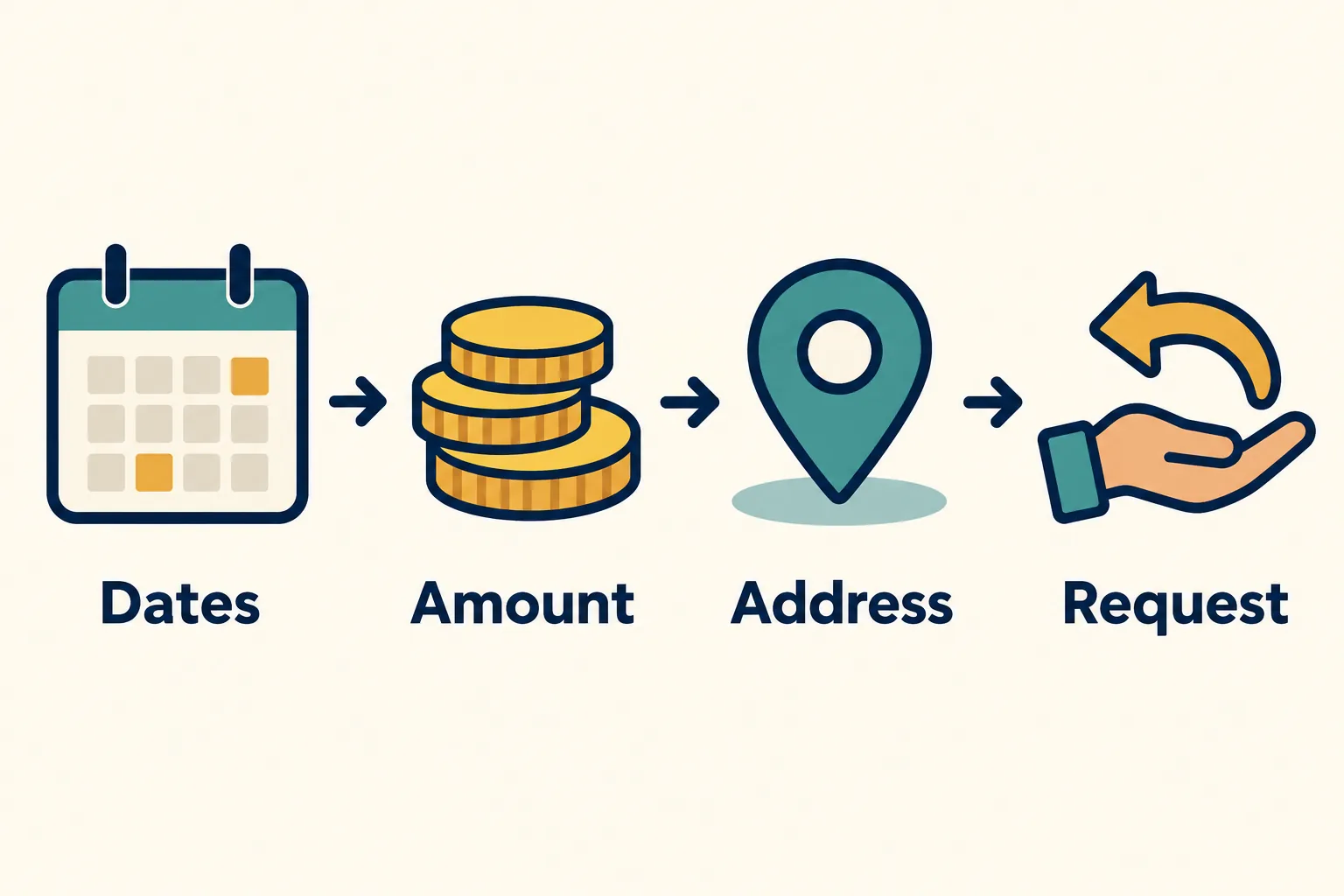
Start with a focused written question. Name the line item, state the fact or document you believe is missing or inaccurate, and ask for the itemized explanation or cost record that the law in your state requires. Keep your original statement and a copy of every response.
If the landlord did not return the balance or you cannot resolve the dispute, check current state court self-help material or contact a local tenant legal-aid office. Court filing names, deadlines, and available remedies vary. Do not assume that a missed deadline automatically produces a particular penalty without checking the statute and facts.
Use clear, fact-based wording
For example: “The statement lists $280 for bedroom carpet repair. My move-in checklist dated May 3 already notes a tear in that area. Please send the repair invoice and explain how the amount was calculated.” This wording identifies the charge and the records you want without claiming a legal result you have not verified.
Where a deduction appears justified but the remaining amount is delayed, ask when the balance will be sent and confirm that the landlord has your current mailing address or delivery instructions. Save proof of delivery for any notice that you send.
Frequently asked questions
Can a landlord charge more than the security deposit?
Possibly, in some jurisdictions and circumstances a landlord may pursue a separate claim for an amount not covered by the deposit. The deposit is not automatically a cap on every possible claim, and it is not proof that the tenant owes the listed amount. Check your state law, lease, and the facts before responding.
Can a landlord deduct cleaning costs from a security deposit?
The answer depends on the property’s state, the lease, the move-in and move-out condition, and the reason for the work. Compare room photos and request a specific description and cost record. California’s official guidance, for example, describes cleaning to restore the unit to its move-in condition; do not assume the same wording controls everywhere.
Does a landlord have to give an itemized list of deductions?
Many states require a written statement or itemization, but the deadline, contents, and exceptions differ. Read the current law for the rental address and compare the landlord’s statement with its requirements. California, Minnesota, and Virginia illustrate that notice rules are not identical.
Can a landlord charge for normal wear and tear?
Many state rules distinguish ordinary wear from tenant-caused damage, but definitions and application depend on local law and the evidence. Compare the same condition at move-in and move-out, consider the item's age, and ask what specific repair was needed. A general label such as “paint” or “carpet” is not enough to explain the facts.
What should I do if my landlord did not return my security deposit on time?
First find the current deadline and notice rule for the state where the rental is located. Confirm that the landlord had your forwarding address or delivery instructions if the statute requires them, then send a dated written request identifying the missing balance or statement. Keep copies and seek local legal aid or court self-help information if the dispute continues.
How do I dispute a security deposit deduction?
List each disputed charge, the fact or record that concerns you, and the specific information you are requesting. Attach copies rather than originals, preserve the lease and dated condition records, and follow your state’s notice procedure. A local attorney or tenant legal-aid office can help assess any deadline or court option.
Official sources and further reading
The examples below are state-specific and were checked on October 2, 2026. Official statutes and current local guidance control over this summary.
- California Attorney General — Landlord-Tenant Issues: Security DepositsCalifornia-specific permitted uses and return statement summary; not a nationwide rule.
- California Department of Real Estate — New LawsSummarizes 2025 AB 2801 security-deposit requirements and restrictions.
- Minnesota Statutes §504B.178Current Minnesota statute on return, allowable withholding, timing, and damages.
- Virginia Code §55.1-1226 — Security depositsCurrent Virginia statutory text; includes categories, itemization, and process details.
- Virginia Law Help — Getting Your Security Deposit BackVirginia-specific tenant steps; do not apply its deadline outside Virginia.
Organize the facts before you write
Use Depossier’s general deposit-check workflow to organize dates, amounts, and evidence. It does not decide whether a deduction is lawful; you review and send any materials yourself.