
U.S. renter guide · reviewed October 2026
Security Deposit Return Letter to Landlord: What to Include and When to Escalate
Use a clear, fact-based letter to ask for a missing deposit balance, a written accounting, or the records behind a disputed deduction. The right next step depends on your state, lease, dates, and evidence.
Last reviewed:
Quick answer
A return letter should make the facts and the requested outcome easy to check.
A security deposit return letter to landlord is usually a written request that identifies the rental, move-out date, original deposit, amount returned, and balance you believe remains due. If the landlord sent an itemized statement, name the exact charge you question and ask for the explanation or records required by the law for your rental.
Use a calm return letter when you are asking for the balance or clarification. Use a more formal demand letter when the first request did not resolve the issue, the accounting is materially incomplete, or you need to state a specific dispute and next step. Neither label decides your legal rights; current state rules and your evidence do.
This is a U.S. residential-rental writing guide, not legal advice. Return deadlines, notice methods, itemization rules, and remedies vary by state, city, lease, housing type, and date.
Security deposit return letter to landlord vs. demand letter
People often use “return letter” and “demand letter” interchangeably, but the tone and job can differ. A return letter can be a first written request: it records the facts, asks when the balance will be sent, and requests a complete statement. A demand letter usually sets out a defined dispute, the amount or records requested, a response date, and what you may consider next if the issue remains unresolved.
Choose the label that matches the stage of the conversation. Do not make a first request sound like a court filing, and do not soften a repeated, documented dispute until the specific missing information disappears. Keep the same accurate facts in either version.
Use a return letter when
You have not yet asked for the unpaid balance, the landlord has not explained a partial refund, or you need to confirm the forwarding address and delivery record. A short, specific request often creates a useful paper trail without arguing every legal issue.
Consider a demand letter when
You already made a dated request, the landlord repeated an unexplained charge, or the amount and documents in dispute are clear. State what you want reviewed and give a reasonable response date that does not contradict a statutory deadline or required notice method.
| Situation | Better starting point | What to say |
|---|---|---|
| No refund or statement | Return letter | Identify the deposit and ask when the balance and accounting will be sent. |
| Partial refund with one unclear charge | Focused return letter | Name the line item, amount, and records you need to evaluate it. |
| Repeated request with no resolution | Formal demand letter | Restate the documented dispute, requested amount or proof, and response date. |
| Possible statutory remedy | Local legal guidance first | Do not promise a penalty; verify the current law and notice procedure before claiming one. |
What to include in a security deposit return letter
Put the most checkable facts near the top. The landlord should be able to match your letter to the lease, payment record, property, and move-out event without guessing. Use one paragraph for the timeline, one for the money, and one for the requested response.
If a fact is uncertain, label it as a question or attach the record that resolves it. Avoid accusations that depend on a legal conclusion you have not verified. A fact-based security deposit refund letter can still be firm.
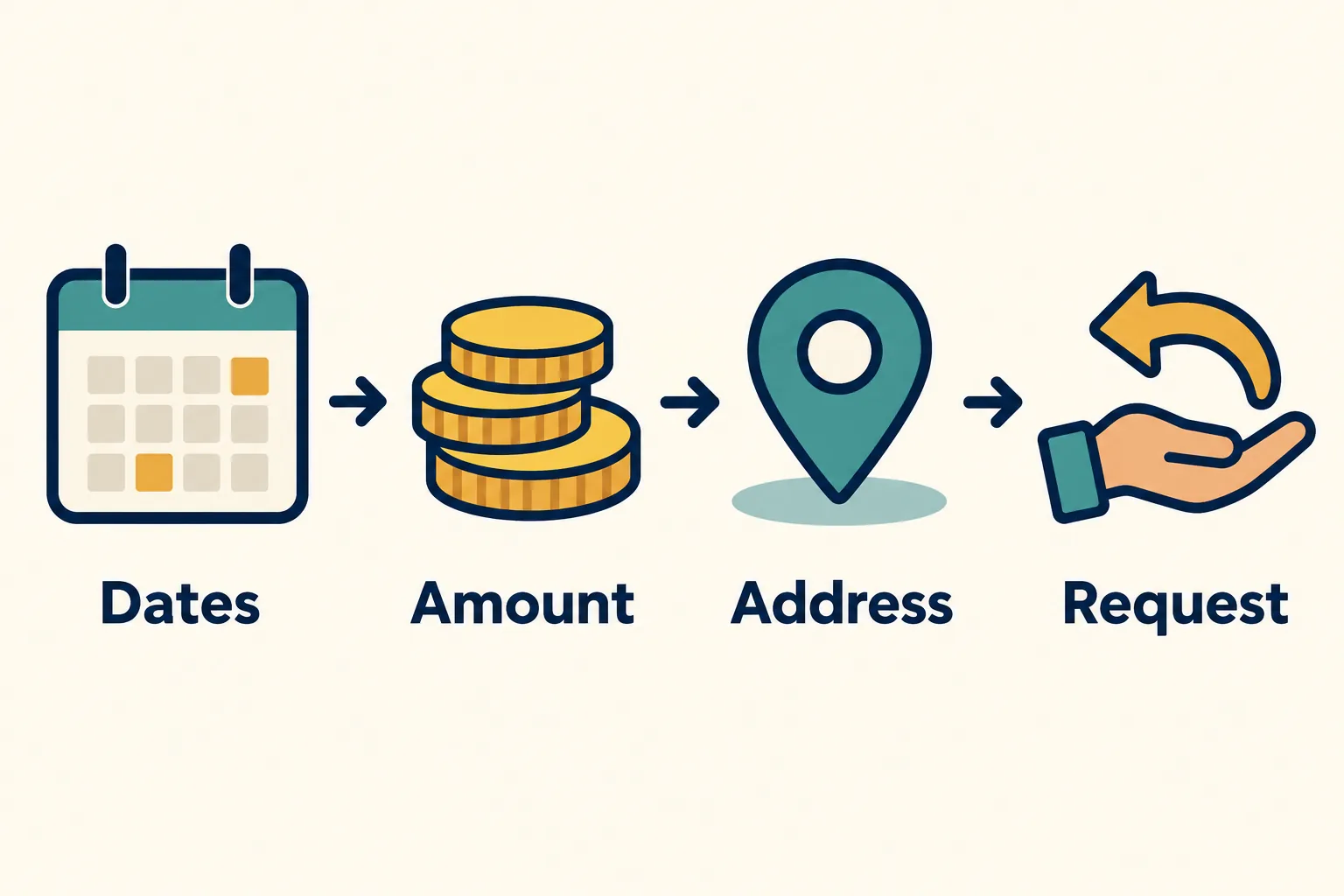
Identify the tenancy and dates
List your name, the rental address, landlord or manager, lease dates if relevant, the move-out date, key-return date, and the date you gave a forwarding address. Keep the original lease and address notice with your copy.
Show the amount in one line
State the original deposit, any amount returned, every listed deduction you dispute, and the balance you are asking the landlord to return or explain. Check the arithmetic before sending. If the statement includes a credit or separate payment, show how your total treats it.
Describe the missing proof
For each disputed charge, identify the room or item, the amount, the condition record that concerns you, and the document you want to review. That could be an itemized explanation, invoice, receipt, photograph, ledger, or calculation, depending on the rule that applies.
- Subject: Security deposit for [rental address] — return or itemized explanation requested
- A short timeline with the move-out and forwarding-address dates
- An amount table or plain-language calculation
- A specific request and reasonable response date
- Your current contact information and a copy saved with delivery proof
How to state the amount and evidence without overclaiming
A useful letter separates arithmetic from eligibility. First show how you reached the balance. Then explain why a line item needs clarification. A balanced statement does not prove that every deduction is allowed, and a missing invoice does not automatically prove that the entire charge is invalid.
Use evidence that a reader can locate: “My move-in checklist dated May 3 lists a carpet tear in the bedroom,” or “The statement lists $280 for repair but does not identify the work date or cost record.” This is stronger than “you stole my deposit” because it tells the recipient exactly what to check.
A simple amount format
Original deposit: $1,800. Amount returned: $1,000. Listed deductions: $400 unpaid rent, $120 cleaning, and $280 repair. Amount currently questioned: $400 repair plus any amount not supported by the applicable rule. Request: return the amount that remains due or explain each charge with the records required for this tenancy.
Evidence that often helps
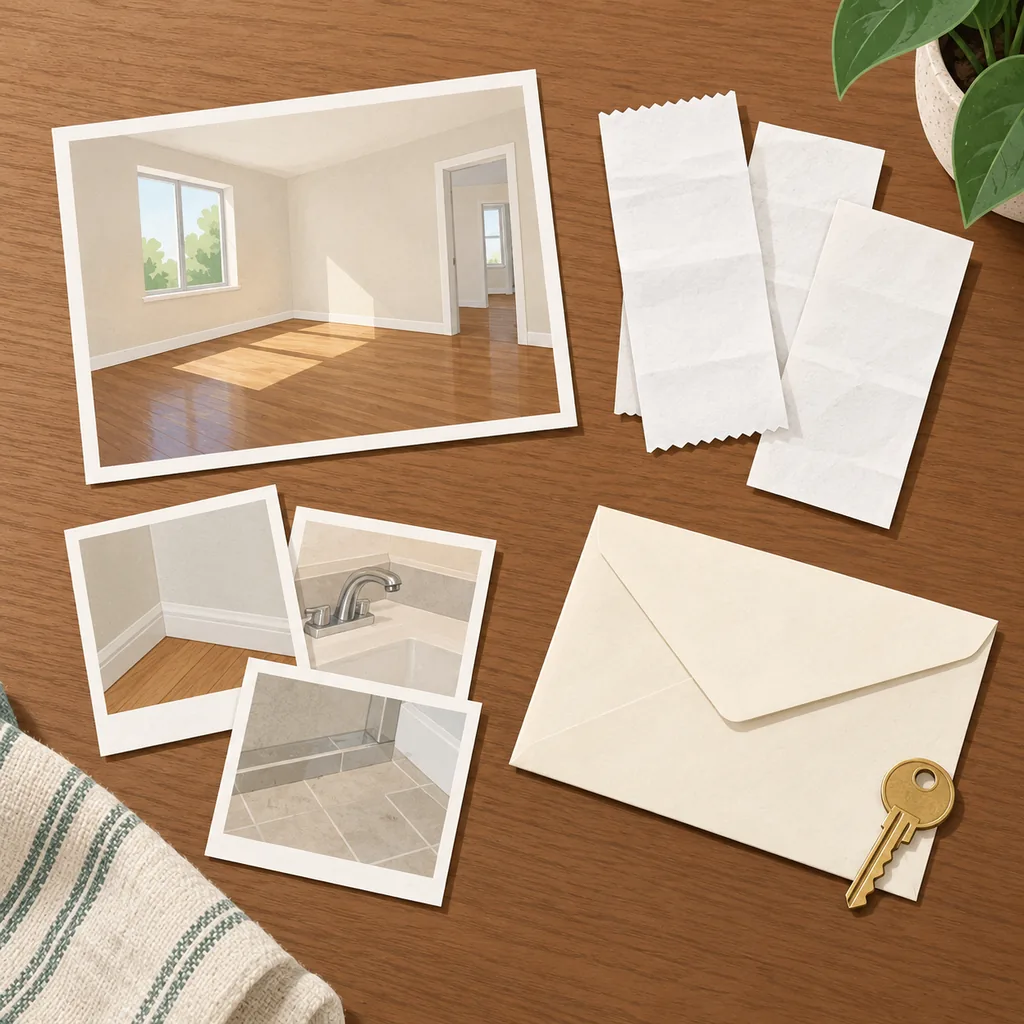
Keep the lease, deposit payment proof, move-in and move-out photos, inspection reports, repair requests, key-return confirmation, messages, itemized statement, invoices, receipts, forwarding-address notice, and proof of delivery. Use only the records connected to your facts.
How to send the letter and preserve proof
Use the notice method that fits the applicable law, lease, and facts. Email can create a fast written copy, while mail or another permitted method may provide a clearer delivery record. A letter is not effective merely because you drafted it; keep evidence of what you sent, where you sent it, and when it was delivered or attempted.
Before sending, check the recipient name, rental address, forwarding address, dates, dollar figures, attachments, and response date. Save the final PDF or text, the email headers or postal receipt, and any reply in the same folder. Do not send original photos or irreplaceable documents.
A practical delivery checklist
Confirm the landlord’s current contact information. Select a method allowed or recommended for the notice. Attach a short index of records. Send from an account you can access later. Record the date, tracking number or sent message, and any returned mail. Follow up only after the response period you stated unless a legal deadline requires earlier action.
When email is not enough
Some states or leases require a particular address, form, or delivery method for a notice. An email may be useful as a duplicate record but may not replace a required method. Verify the current official rule for the rental address before relying on email alone.
Check the state rule before choosing a deadline
There is no single U.S. security deposit return deadline or universal security deposit return letter template. State law can change the time to return a balance, the contents of an itemized statement, the address a tenant must provide, the delivery method, interest, and any remedy. Local ordinances, housing type, lease language, and the tenancy dates can add facts that a national guide cannot resolve.
For example, Depossier’s existing California guide discusses a 21-calendar-day accounting rule and current photo/document requirements; the Minnesota guide discusses a generally three-week period with address conditions; the Connecticut guide explains its own timing and interest sources. Use those pages as starting points, then read the official source for your property.
A safe research sequence
Find the official state statute or court/agency guidance. Confirm the rule’s trigger date and required tenant notice. Compare the landlord’s statement with the required contents. Record the source date and keep a copy. If the amount or deadline is important, ask a local legal-aid office or attorney to apply the rule to your facts.
- Locate the rule for the rental address
Do not use a different state’s deadline because the wording looks similar.
- Separate the balance from the dispute
Ask for the uncontested balance while listing the exact charge or record you question.
- Match the delivery method
Use the address and method required or recommended by the current rule and preserve proof.
- Escalate with local guidance
A possible penalty, court claim, or unusual lease term deserves state-specific advice.
A concise sample structure
The following outline shows the order of information, not a guaranteed legal form. Replace every bracketed field, remove anything that is not true, and verify the applicable notice rule before sending.
Opening and timeline
I rented [address] under [lease or account reference]. I moved out and returned the keys on [date]. I provided a forwarding address on [date]. The original security deposit was [$amount].
Request and disputed item
Please return the remaining balance of [$amount] or provide the itemized explanation and supporting records required for each deduction. I specifically request clarification of [$charge] because [fact or record]. Please respond in writing by [date], subject to any earlier deadline required by applicable law.
Close and preserve
I have attached copies of [short record list]. Please use [address/email] for your response. I am keeping a copy of this request and the delivery record.
Security deposit return letter questions
What is a security deposit return letter to a landlord?
It is a written request that identifies the rental, move-out date, original deposit, amount returned, balance requested, and records needed to review disputed deductions. The deadline and delivery method depend on the rental's state and facts.
What is the difference between a security deposit return letter and a demand letter?
A return letter is often a first request for the balance or accounting. A demand letter usually sets out a documented dispute, specific amount or records requested, response date, and possible next step. The labels do not determine legal rights.
What should I include in a security deposit refund letter?
Include the rental address, tenancy reference, move-out and key-return dates, forwarding-address date, original deposit, amount returned, disputed line items, evidence-based questions, requested response, contact information, and relevant copies.
Can I send a security deposit return letter by email?
Email may create a useful copy, but it may not replace a notice method or address required by state law or the lease. Verify the current rule, confirm the recipient, and save delivery evidence.
How long should I give a landlord to respond?
Use a reasonable response date that does not override an earlier statutory deadline or required notice method. State law controls the return and notice period; a letter cannot extend it.
What if my landlord did not return my security deposit?
Gather deposit proof, move-out date, forwarding address, itemized statement, messages, photos, and delivery records. Send a focused written request, verify the state rule, and seek local legal-aid or court self-help guidance if the dispute continues.
Official sources and further reading
The links below are starting points for current state rules. They do not create a nationwide deadline or replace advice for your rental.
- California Attorney General — Landlord-Tenant Issues: Security DepositsCalifornia-specific permitted uses and return/accounting guidance.
- Minnesota Statutes §504B.178Minnesota-specific return timing, withholding, address conditions, and interest.
- HUD — State and Local Tenant Rights ResourcesUse the official state and local resource directory to find current housing guidance.
Organize the facts before you send
Use Depossier’s free Deposit Check to lay out the state, deposit, returned amount, move-out date, itemization status, and evidence status. You review and send any letter yourself.