
U.S. renter guide · reviewed October 2026
Landlord Did Not Return Your Security Deposit? 7 Steps to Take
Start with the facts: confirm the move-out timeline, calculate the missing balance, request the records behind any deduction, and preserve a clear paper trail before you escalate.
Last reviewed:
Quick answer
A missing deposit needs a dated, evidence-based follow-up before it needs a stronger label.
If a landlord did not return your security deposit, first gather the lease, payment record, move-out and key-return dates, forwarding-address notice, refund statement, and every message about the balance. Then check the current rule for the state and housing type where the rental is located. Deadlines and required itemization are not nationwide rules.
Send a written request that states the amount returned, the amount you believe is missing, and the documents or explanation you need. If the landlord already sent an itemized statement, name each disputed line item instead of making a general accusation. Keep the original records, send copies, and save delivery proof.
This guide provides general U.S. rental information, not legal advice. Verify the current law for the rental address before relying on a deadline, penalty, or court remedy.
1. Rebuild the move-out and deposit timeline
A useful follow-up starts with dates that another person can verify. Write down when the lease ended, when you physically moved out, when keys or access devices were returned, when the landlord received your forwarding address, and when you received any check, transfer, or itemized statement. If the lease ended before you left, record both dates and explain which one the landlord used.
Do not assume the date printed on a check proves the date it was mailed or delivered. Keep the envelope, tracking record, email timestamp, portal screenshot, and bank posting date when available. A timeline can show whether you are waiting for money, waiting for an accounting, or disputing the amount that was already sent.
Make a simple event log
Use one row for each event and save the source of the date. For example: May 31 lease end; June 2 keys returned; June 3 forwarding address emailed; June 28 partial refund received; July 5 itemized statement requested. This is more reliable than trying to reconstruct the sequence from memory when you are upset or the messages are spread across several apps.
Check the rule for the property
State statutes, local ordinances, the lease, and special housing rules can change the deadline, notice format, interest treatment, and documents required with a deduction. Use an official state or court source as the starting point. A general article can help you prepare questions, but it cannot replace the rule for your address.
- Lease start and end dates
- Move-out and key-return dates
- Forwarding address and delivery instructions
- Date and amount of every payment or statement
- Screenshots, envelopes, tracking, and bank records
2. Reconcile the deposit, refund, and disputed charges
Calculate the balance without rounding away a disputed line. Start with the original deposit, subtract each payment you actually received, and list every charge the landlord says it kept. Then mark which charges you accept, which you question, and which have no description or supporting record. A clean calculation helps the landlord answer one question at a time.
Separate a missing balance from a disagreement about a deduction. If the landlord returned $900 from a $1,500 deposit and listed $600 for cleaning, your request can ask for the $600 explanation and the records supporting the work. If the statement also includes a $200 credit or an earlier payment, show exactly how your requested total treats it.
Use an amount table
A small table prevents a broad demand from hiding an arithmetic mistake. Include the claimed charge, the amount, the document supplied, your evidence, and the action you want. You can attach the table to a letter or use the same rows in an email.
Avoid a legal conclusion as a substitute for facts
Labels such as illegal, theft, fraud, or automatic penalty can make a first request harder to resolve when the rule or record is still unclear. Say what is missing: an itemized description, invoice, photograph, calculation, or explanation of how the charge relates to the condition at move-in. Ask a local legal-aid office about the legal consequence after the facts are assembled.
- Original deposit: $____
- Payments received: $____
- Each listed deduction and amount
- Charges you accept, question, or cannot verify
- Balance or records requested
| Record | Question to answer | Keep with your file |
|---|---|---|
| Deposit payment | How much was paid and when? | Receipt, ledger, bank entry |
| Refund | What amount arrived and on what date? | Check image, transfer, envelope |
| Deduction | What work or loss does the line describe? | Statement, invoice, photos |
| Requested balance | What exact dollars or records are still missing? | Your calculation and dated request |
3. Ask for the accounting and proof behind a deduction
If the landlord has not returned the deposit or has kept part of it, ask for the specific information that would let you evaluate the charge. Depending on the law and the lease, that may be an itemized statement, repair invoice, receipt, photograph, contractor record, labor calculation, or explanation of how the amount was allocated. Do not demand a document that your state does not require as though it were universal; phrase it as a request for the records applicable to your tenancy.
Tie each question to one line item. For example: “The statement lists $280 for bedroom carpet repair. My move-in checklist notes a tear in that area. Please send the repair invoice and explain how the amount was calculated.” This is more useful than saying the entire statement is fake, and it gives the landlord a concrete way to respond.
Compare condition records
Look at move-in and move-out photos, inspection forms, maintenance messages, and the age of the item. Normal wear, pre-existing damage, tenant-caused damage, cleaning, and unpaid rent can be treated differently by different rules. Your comparison does not decide the legal result; it identifies which facts and records need an answer.
State the response you want
Ask for the missing balance, a corrected statement, the records behind a charge, or a date by which the landlord will respond. If you are willing to accept a supported charge, say so without waiving other issues. Keep your request narrow enough that a reader can answer it in one reply.
- List the line item
Copy the description and amount exactly as shown.
- Name the missing support
Ask for the applicable itemization, invoice, photograph, or calculation.
- Attach the matching fact
Reference the dated photo, checklist, lease clause, or message that raises the question.
- Ask for a specific response
Request the balance, corrected explanation, or next date in writing.
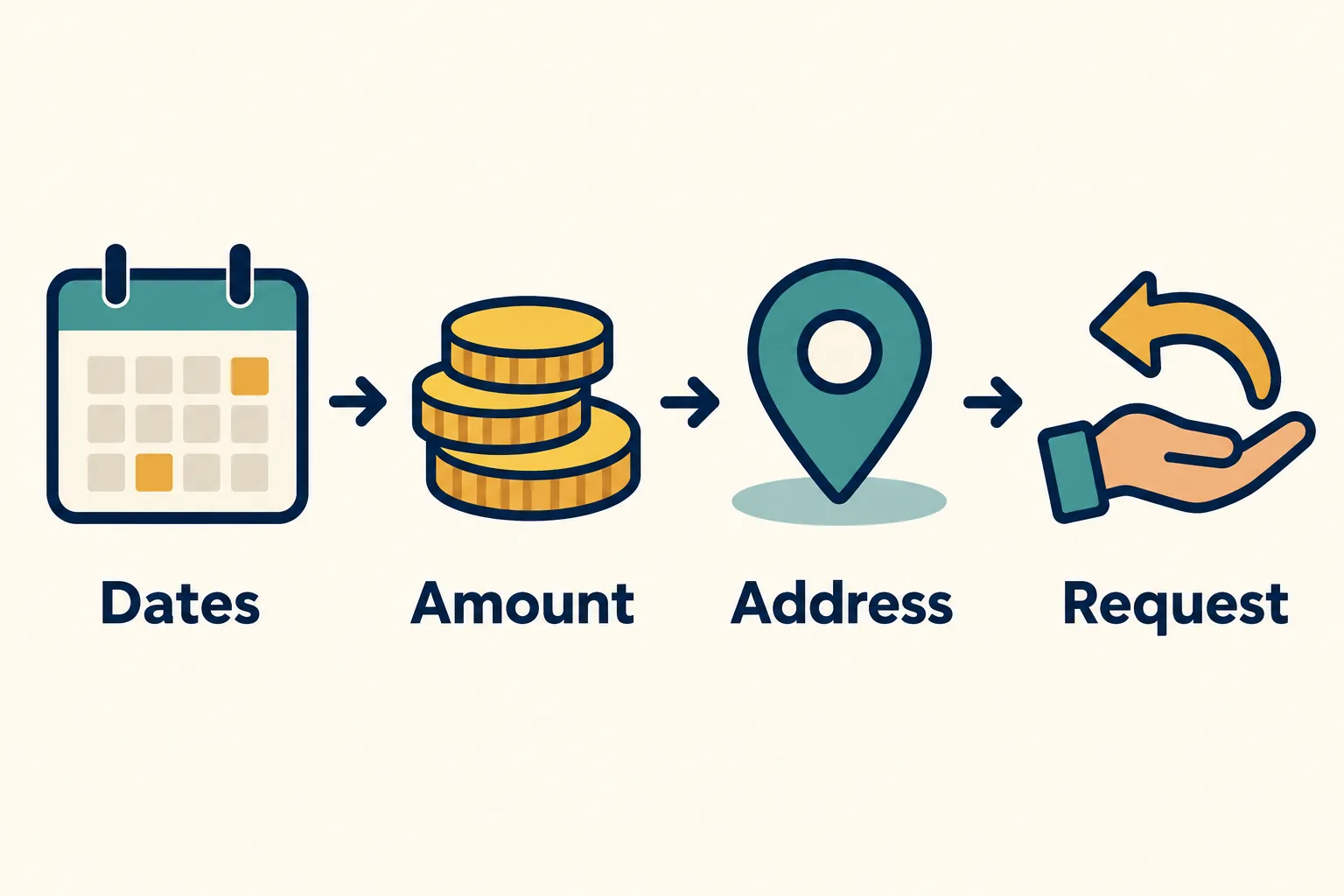
4. Send a written request you can prove later
Choose the delivery method required by the current rule or lease, and use a second channel when it helps you preserve a record. A letter, email, tenant portal message, or certified delivery can each be useful in the right setting. The goal is not to use the most dramatic method; it is to show what you sent, where you sent it, and when it was received or attempted.
Use a descriptive subject line and put the requested response near the top. Include the rental address, the dates, the amount calculation, the disputed line items, the records requested, your current mailing address, and a reasonable response date. Do not set a private deadline that conflicts with a statutory notice period or pretend that non-response proves a legal victory.
Delivery checklist
Save the final letter as a PDF or plain text, keep the exact attachments, record the destination address, and preserve the sent timestamp or tracking number. If mail is returned, keep the envelope and note what you did next. If you use email, keep the full thread and any delivery or bounce notice.
Keep the tone firm and neutral
Describe the problem, identify the missing facts, and state the outcome you want. Avoid threats, public accusations, or claims that you have already won. A neutral record can be reused if you later ask a tenant clinic, court self-help center, or attorney to review the dispute.
- Use the landlord or manager address in the lease and the address required by current state guidance
- Attach copies, not irreplaceable originals
- Keep a sent copy that includes every attachment
- Save delivery, tracking, portal, and bounce records
- Use the same dates and amounts in later follow-ups
5. Follow up without overclaiming a remedy
If there is no response, send one short follow-up that points back to the first request. Repeat the date sent, the amount or documents still missing, and the response you are asking for. Do not restart the entire argument in every message. A consistent paper trail makes it easier to see whether the dispute is about delivery, arithmetic, a missing accounting, or the legal treatment of a charge.
When a deadline, substantial amount, habitability issue, retaliation concern, or court filing is involved, get local help before choosing the next step. State and city rules can provide different notice procedures, interest rules, fee shifting, or remedies. A tenant legal-aid office, court self-help center, or licensed attorney can apply those rules to your facts.
A simple follow-up sequence
First request: ask for the balance or supporting records. Follow-up: identify what remains unanswered and attach the first delivery proof. Local review: bring the lease, timeline, calculation, statement, photos, and messages in one folder. Court or formal claim: use the current filing and notice instructions for the location, not a generic online checklist.
Know when a template is not enough
A template can organize facts, but it cannot decide whether a landlord missed a legal deadline, whether a deduction is permissible, or which court has jurisdiction. If the amount is meaningful or the facts are disputed, spend the next effort on local verification instead of making the language more aggressive.
- Wait using the rule that applies
Use the current state, city, lease, and delivery requirements rather than an internet-wide number.
- Send one focused follow-up
Point to the unanswered amount or record and include the first delivery proof.
- Get local review
Bring the complete file to legal aid, court self-help, or a local attorney when the stakes justify it.
6. Know when to get local tenant help
Consider local help when the deposit is large, the landlord claims unpaid rent or major damage, the rental is in a regulated housing program, the notice deadline is close, or the dispute includes retaliation, discrimination, or habitability concerns. Those facts can change the procedure and the risk of sending an incomplete notice.
Bring a compact file: lease, deposit receipt, move-in and move-out records, forwarding-address proof, refund or deduction statement, your calculation, messages, photos, and delivery records. Ask the reviewer to separate what the documents prove from what still needs a legal answer. That distinction keeps your written request accurate and easier to update.
Questions to ask a local resource
Ask which deadline applies, whether a specific notice method is required, what an itemized statement must contain, whether interest or a separate remedy is possible, and which court or agency handles the next step. Give the rental address and dates, because a general state summary may not cover local rules or special housing.
Protect your privacy
Share only what the reviewer needs. Redact bank account numbers, Social Security numbers, unrelated medical information, and other tenants' personal data. Keep a private original folder and a separate copy you can safely email.
- The amount or deadline could materially affect you
- The landlord alleges unpaid rent or extensive damage
- The property has special program or local rules
- You suspect retaliation, discrimination, or habitability issues
- You are considering a court filing or statutory claim
Questions after a landlord has not returned a deposit
What should I do if my landlord did not return my security deposit?
Rebuild the move-out timeline, calculate the missing balance, check the current rule for the rental address, and send a dated written request for the balance or the records behind each deduction. Keep copies and delivery proof.
How long can a landlord hold a security deposit?
The deadline varies by state, city, lease, housing type, and facts. Check the current official rule for the rental address instead of relying on a nationwide number.
What if the landlord sent an itemized deduction statement?
Compare each line with your move-in and move-out records, identify the charge you question, and request the explanation or supporting records that apply to your tenancy.
Should I send a demand letter if the landlord has not returned the deposit?
A focused return request can be a reasonable first step. A more formal demand may fit after a documented request remains unresolved, but the facts, notice method, and state rule matter more than the label.
What proof should I keep when disputing a security deposit?
Keep the lease, deposit receipt, dates, forwarding-address proof, refund or deduction statement, photos, inspection records, messages, your calculation, and delivery confirmation.
When should I contact a tenant lawyer or legal-aid office?
Get local help when the amount or deadline matters, the landlord alleges significant damage or unpaid rent, special housing rules apply, or you are considering a court or statutory claim.
Official sources and further reading
The links below are starting points for current U.S. rental and state guidance. They do not create a nationwide deadline or decide the facts of your tenancy.
- HUD — Tenant rights and responsibilitiesGeneral federal housing information; state and local rules still control deposit procedures.
- California Attorney General — Security depositsCalifornia-specific examples of permitted deductions and accounting; do not apply it outside California.
- Minnesota Statutes section 504B.178Minnesota-specific statutory text on return timing, withholding, and damages.
- Connecticut Department of Banking — Security depositsConnecticut-specific consumer guidance; check the current page for applicable facts and deadlines.
Organize the facts before you send the next message
Depossier can help you collect dates, amounts, deductions, and evidence into a clearer deposit-check workflow. You review and send any letter or email yourself; the tool is not a law firm and does not contact the landlord.